GPR Scanning & Rebar Detection Services in Qatar
Aseel Constructions provides non-destructive GPR scanning in Qatar to locate rebar, post-tension cables, conduits, and voids before any concrete cutting or drilling operation. Our ground-penetrating radar technology uses safe, zero-radiation electromagnetic pulses to create real-time images of what lies beneath the concrete surface. Since 2016, our trained GPR scanning operators have helped contractors across Doha and Qatar avoid costly damage to embedded services and structural reinforcement. Whether you need a quick pre-coring scan to verify rebar locations or a comprehensive structural assessment mapping every element within a slab, our concrete scanning service delivers the critical information your project needs. We use state-of-the-art equipment capable of detecting objects at depths exceeding 500mm, with results marked directly on the concrete surface and documented in detailed reports for your project records.
How GPR Scanning Works
Project Briefing
We discuss your project requirements, identify the areas to be scanned, and determine what objects or features need to be located - rebar, PT cables, conduits, or voids.
Surface Preparation
The concrete surface is cleaned of loose debris to ensure good antenna contact. The scan area is laid out with a reference grid for accurate positioning of detected objects.
Radar Scanning
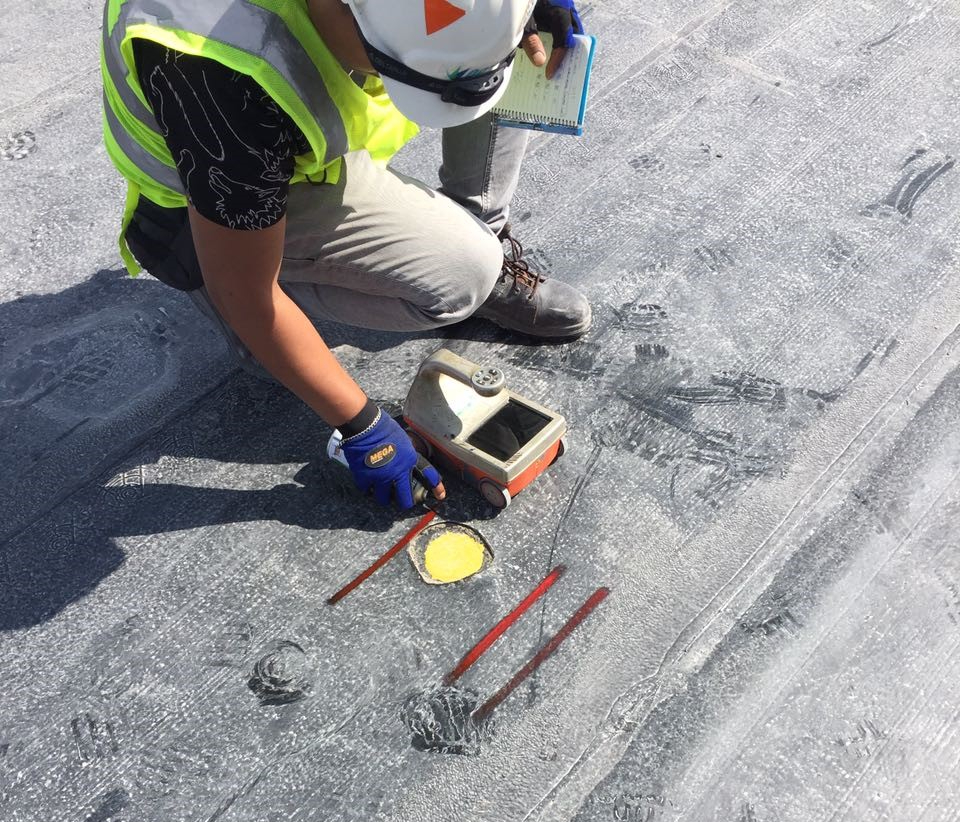
The GPR antenna is passed across the concrete surface, transmitting radar pulses and receiving reflections from embedded objects. Data is displayed in real time on the control unit.
Interpretation & Marking
Our trained operator interprets the radar data, identifies all detected objects, and marks their locations directly on the concrete surface using color-coded markers.
Reporting
A detailed report is prepared with scan findings, object depths, safe zones for drilling or cutting, and any recommendations. Digital scan data is available upon request.
Common Applications
Pre-Coring Rebar Detection
Scanning before core drilling to locate rebar and determine safe drilling positions that avoid cutting primary structural reinforcement.
Post-Tension Cable Location
Identifying the exact path of post-tension cables before any cutting operation to prevent catastrophic cable damage and structural failure.
Embedded Conduit Mapping
Locating electrical conduits, PVC pipes, and other embedded services to plan safe cutting paths and avoid service disruptions.
Void Detection
Identifying voids, honeycombing, and delamination within concrete slabs and walls for structural assessment and quality control.
Slab Thickness Measurement
Determining concrete slab thickness without destructive testing, essential for planning cutting depths and structural load calculations.
Structural Assessment
Comprehensive scanning of structural elements to map reinforcement layout, cover depth, and identify areas of potential concern.
Our Equipment & Capabilities
| Specification | Details |
|---|---|
| Technology | Ground Penetrating Radar (zero radiation) |
| Display | Real-time imaging with on-screen visualization |
| Detection Targets | Rebar, PT cables, conduits, voids, and density changes |
| Penetration Depth | Up to 500mm+ depending on concrete conditions |
| Method | Completely non-destructive, no surface damage |
| Accuracy | Position accuracy within 10-15mm, depth within 5-10% |
| Output | On-site marking plus written reports with scan data |
Safety & Compliance
GPR scanning is inherently one of the safest inspection methods available. Unlike X-ray or radiographic testing, GPR uses no ionizing radiation and requires no area evacuation or radiation safety protocols. Our equipment emits low-power electromagnetic pulses that are completely harmless to operators and bystanders. Scanning can be performed in occupied buildings, hospitals, schools, and sensitive environments without any health risk. All our GPR operators are trained in equipment operation and data interpretation, ensuring reliable results that help prevent costly and dangerous incidents during subsequent cutting or drilling operations.
Frequently Asked Questions
GPR detects anything embedded in concrete that has a different electromagnetic signature from the surrounding material: rebar, post-tension cables, PVC conduits, metallic pipes, and voids. It also measures slab thickness from a single-sided scan.
It won't reliably detect thin plastic sheeting or small-diameter conduit in wet, high-chloride concrete - known limitations. For pre-coring and pre-cutting scans on Qatar construction sites, GPR gives contractors what they need: rebar spacing, PT cable paths, and confirmed safe drilling zones.
GPR uses no ionizing radiation. That's the key difference from X-ray scanning, which requires area evacuation, dosimetry, and a radiation safety officer. GPR emits low-power electromagnetic pulses - effectively radar - that are harmless to everyone nearby.
It can be carried out inside occupied offices, active hospitals, and functioning schools without disrupting operations. No radiation work permits, no floor closure. That's why it's the standard NDT method for pre-coring scans on live construction sites across Doha.
Lateral position accuracy for rebar and metallic objects is typically within 10 to 15mm. Depth accuracy runs within 5 to 10% of the actual embedment depth. The limiting variables are concrete moisture content and chloride contamination, which affect signal velocity.
Our operators calibrate against a known reference - a physical measurement, a known slab thickness, or an exposed bar - before scanning production areas. That step separates a calibrated result from an estimate.
A pre-coring scan for a single location takes 15 to 20 minutes including setup, scanning the area around the marked position, and marking results on the slab. A room-by-room rebar mapping exercise before breaking out a slab section runs 1 to 3 hours depending on area and reinforcement density.
For large structural assessments, we plan scan coverage with the site engineer in advance so scope and mobilization cost are agreed before work starts.
Yes. Rebar lines are marked on the concrete using color-coded paint or chalk: one color for bars running in one direction, a second for the perpendicular layer, and a distinct marker for PT cables. Safe zones for drilling or cutting are clearly called out.
A written scan report accompanies every job, covering object depths, spacing, and the operator's recommendations. Digital scan images are available on request for project records.