A fit-out contractor on a tower project in Lusail needed fourteen new door openings cut through 250 mm reinforced concrete walls. The subcontractor they hired brought a core drilling rig. Forty-eight hours later, they'd finished two openings using stitch drilling, burnt through six core bits, and left jagged edges that needed grinding before the door frames could be installed. The right tool for that job was a wall saw. It would have finished all fourteen openings in three days with clean, straight cuts.
Concrete cutting (قطع خرسانة الدوحة) in Qatar covers four distinct methods: wall sawing, floor sawing, wire sawing, and core drilling. Each exists because the others can't do its job efficiently. The mistakes happen when contractors pick based on what equipment is available rather than what the cut actually requires.
Wall Sawing: The Method Built for Concrete Cutting in Qatar's Vertical Structures
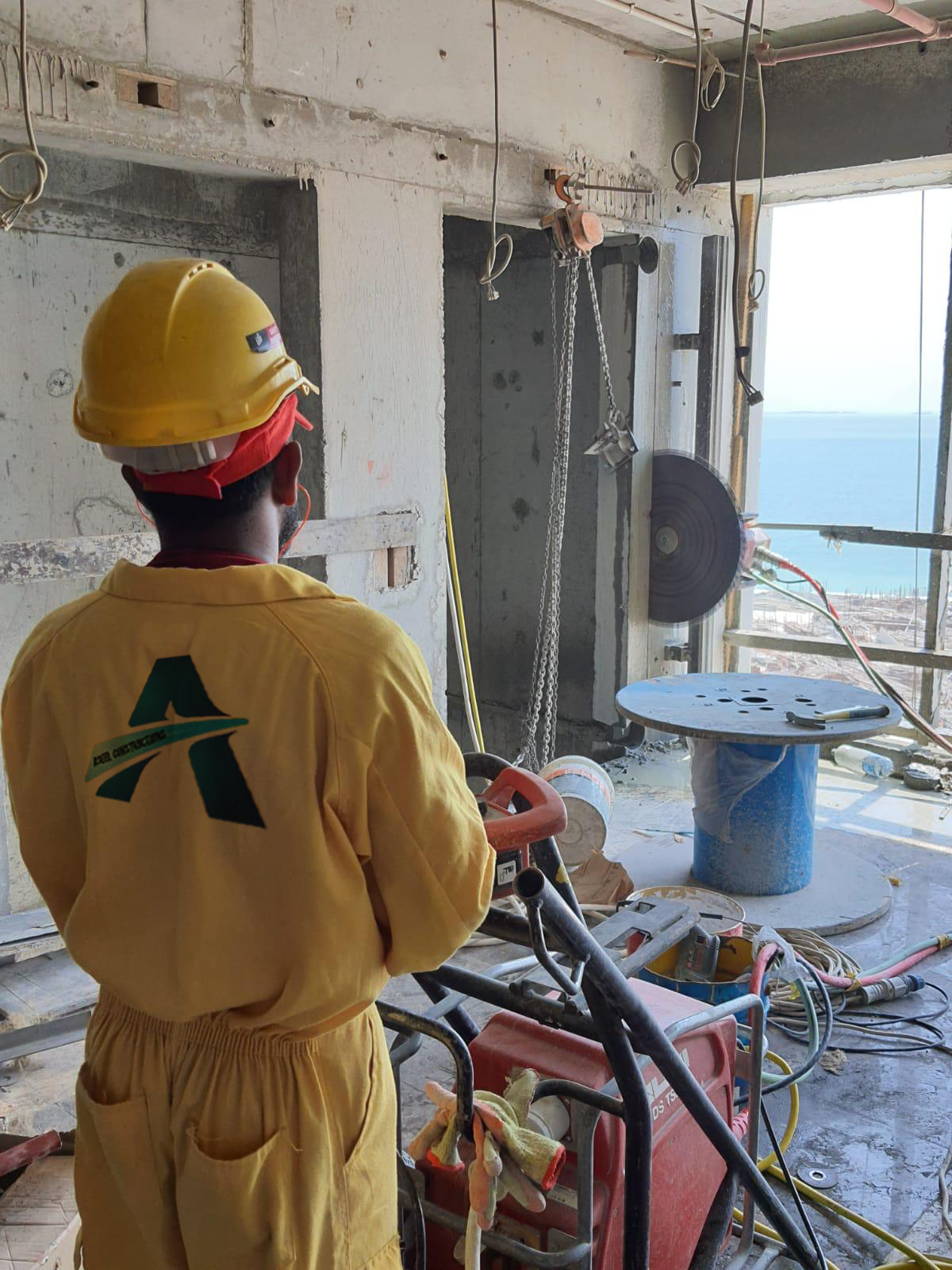
Wall sawing uses a diamond blade mounted on a track-guided system bolted directly to the concrete surface. The blade travels along a fixed rail, producing straight, precise cuts with tight tolerances. Standard blades cut up to 730 mm deep in a single pass. Deeper walls require cutting from both sides.
This is the correct method for door openings, window modifications, HVAC penetrations larger than 500 mm, and any rectangular or square cut through a wall, slab edge, or column face. On Doha high-rise projects, wall sawing handles the bulk of structural modification work during fit-out phases.
The blade track needs a flat mounting surface and anchor points. If the wall finish is uneven or the concrete is severely honeycombed, the track won't sit flush, and the cut will deviate. Check the surface before the crew starts drilling anchor holes for the rail.
Floor Sawing: Flat Slabs, Road Surfaces, and Expansion Joints
Floor sawing in Qatar runs constantly on road and infrastructure projects. The machine is a walk-behind or ride-on saw with a vertical diamond blade that cuts downward into horizontal surfaces. Typical applications include road joint cutting, trench cutting for utility runs, slab removal sections, and controlled demolition lines.
Blade diameter determines maximum cut depth. A 900 mm blade cuts roughly 350 mm deep. For thicker slabs, the cut is completed from below using a wall saw or the slab is lifted after partial cutting.
On Ashghal road projects across Qatar, floor sawing is specified for creating clean joint lines in new pavement and for cutting service trenches in existing roads. The kerf width is narrow, typically 4 to 6 mm, which minimises material loss and reduces reinstatement costs. Summer scheduling matters here too: asphalt softens above 50°C, and a floor saw pulling through soft asphalt creates a ragged cut that won't hold a sealant joint.
Wire Sawing: When the Other Methods Can't Reach
Wire sawing is slower and more expensive than wall or floor sawing. That's not a criticism. It handles cuts that no blade can physically make.
The system uses a continuous loop of diamond-beaded wire threaded around the object to be cut. A hydraulic drive unit pulls the wire at controlled speed and tension while water cools the diamonds. Wire sawing cuts through any shape, any thickness, and any angle. It doesn't need a flat surface to mount a track. It doesn't have a maximum depth limitation.
Typical uses in Qatar include removing large concrete sections from bridge decks, cutting through heavily reinforced pile caps, demolishing thick raft foundations, and making cuts in confined spaces where a blade can't be positioned. On a recent type of infrastructure project in Doha, wire sawing was the only viable method for removing a 1.5 m thick retaining wall section that sat against an active utility corridor. No blade could reach the full depth, and the adjacent services ruled out percussive demolition.
Wire sawing also generates less vibration and noise than blade cutting, which makes it the better option near sensitive structures or occupied buildings.
The Method Selection Mistake Most Contractors Make in Qatar
The most common error isn't choosing the wrong method outright. It's defaulting to core drilling for every opening because the contractor owns a coring rig and doesn't want to bring in a specialist concrete cutting company. Stitch drilling, which means drilling overlapping cores to create a rectangular opening, is a legitimate technique for small openings. For anything larger than about 400 mm x 400 mm, it's the slowest, most expensive, and least precise option compared to a wall saw.
A wall saw cuts a 900 mm x 2100 mm door opening in a 200 mm wall in under an hour. Stitch drilling the same opening with a 100 mm core bit requires roughly sixty overlapping cores and leaves a rough, scalloped edge. The grinding and patching to make that edge frame-ready adds time and cost that exceed what the saw cut would have cost from the start.
Get the method right at the procurement stage. Specify it in the subcontract scope. Don't leave it to the crew on the day.
GPR Before Any Concrete Cutting Method
Every cutting method described here will sever a post-tension cable, rebar mat, or embedded conduit just as effectively as it cuts clean concrete. GPR scanning is required before wall sawing, floor sawing, and wire sawing, not only before core drilling. The scan identifies tendon paths, rebar spacing, and conduit locations so the cut lines can be positioned safely.
On post-tensioned structures, which cover most commercial buildings constructed in Qatar over the last fifteen years, a single severed tendon can trigger progressive structural failure. The scanning step takes less time than one saw cut. Don't skip it.
For projects anywhere in Qatar that need a licensed concrete cutting company with the right saw for the job, contact Aseel Constructions for a site assessment. The team carries wall saws, floor saws, wire saws, and GPR units, and selects the method based on what the cut requires, not what happens to be on the truck.
Looking for a Concrete Cutting Specialist in Qatar?
Aseel Constructions provides licensed concrete cutting services across Qatar, including wall sawing, floor and road sawing, wire sawing, and full GPR scanning support. From single openings to full structural modification packages, the team delivers precision cuts on schedule.
Get a Free Quote